REVIEW · CHARLESTON
Charleston Footprints Walking Tour
Book on Viator →Operated by Charleston Footprints Tours · Bookable on Viator
Charleston history, served at walking speed. This Charleston Footprints Walking Tour turns the city into a story you can follow on foot, with a route paced for a 2 to 2 hours 15 minutes outing and a mobile ticket you can show on the spot. You get landmark-to-landmark context that connects the port, the churches, and the grand homes to what Charleston became next, and they note that no two tours are exactly the same.
What I like most is the way the guides keep the narrative moving while still leaving room for questions. If you get Al or Eric, you’re in good hands: both come up in the write-ups for energetic, detailed answers and a real sense of hometown storytelling. The other big plus is the stop list lines up with major sites that show as free admission tickets for what you’ll see on the walk. The only real caution: a couple of reservation-system problems and one rare guide no-show have shown up in past experiences, so I’d screenshot or keep your confirmation and double-check the morning of—just to keep your day easy.
In This Review
- Key things that make this tour worth your time
- Why This 2-Hour Charleston Walk Fits Your Trip
- What the Small Group Pace Feels Like (and Why It Matters)
- Starting Point on Meeting Street: Getting Oriented Fast
- Old Exchange and Provost (1771): The Port That Held Power
- Rainbow Row: Preservation as an Idea, Not Just a Photo
- St. Michael’s Church (1761): Tiffany Glass and Atlantic-Bound Bells
- Dock Street Theater: When Old Ground Gets a Second Life
- St. Philip’s Church: Deep Roots from 1680
- Circular Congregational Church: The Quiet Power of Slate Tombstones
- Powder Magazine (1713): Fortified Storage with a Big Engineering Idea
- Nathaniel Russell House: Federal-Era Elegance and a Designed Garden
- Battery and White Point Gardens: Waterfront Drama You Can See
- The Gibbes: Southern Art Since 1858
- Pink House Gallery: Entertainment with a Name You Can Believe
- Powder Magazine Again: The Brutal Physics of Gunpowder Storage
- How Much Walking Is This, Really?
- Who This Tour Is Best For
- Should You Book Charleston Footprints Walking Tour?
- FAQ
- How long is the Charleston Footprints Walking Tour?
- How much does it cost?
- Where does the tour start, and where does it end?
- Is the tour limited to a small group?
- Is it wheelchair and stroller accessible?
- Is a mobile ticket provided?
- What language is the tour offered in?
- Does the tour include lunch or alcoholic beverages?
- What if weather is bad?
Key things that make this tour worth your time
- 90 years of combined guiding experience helps the walk feel like a tight story, not random facts.
- Free-site stop-ins add value because you’re not paying extra at every corner.
- No two tours are exactly the same, so repetition won’t feel like a rerun.
- Wheelchair and stroller accessible, so you can keep moving without constant detours.
- Small group size (max 20) makes it practical to ask questions and hear answers.
- A route that mixes civic Charleston, churches, waterfront views, and art/entertainment spots so you get variety in two hours.
Why This 2-Hour Charleston Walk Fits Your Trip
Charleston works best when you do short, focused blocks of sightseeing. This tour is built for that reality. At roughly 2 hours to 2 hours 15 minutes, it’s long enough to connect big historical dots, but short enough that you won’t feel like your whole day is gone.
The price—$28.50 per person—isn’t just for the stroll. You’re paying for a guide’s pacing and interpretation, and the stop list is set up with multiple locations that are marked as free admission tickets. So you’re getting guided value more than you’re buying “entry fees.”
Also, the start is in a super walkable, central area (Meeting St), which matters because Charleston streets can eat time if you’re constantly repositioning yourself.
Other walking tours we've reviewed in Charleston



What the Small Group Pace Feels Like (and Why It Matters)
The tour caps at 20 travelers, which changes the vibe. You can actually hear what’s being said without playing sidewalk dodgeball. And because the duration is tight, the guide doesn’t wander off into long detours that drain your energy.
A small group also makes it easier to ask questions. I like tours where I can raise my hand and get a real answer rather than a polite nod that never quite lands. The guides here are repeatedly described as entertaining and able to respond to questions in detail, which is exactly what you want on a history-heavy walk.
One more practical note: the tour is in English, and it uses a mobile ticket. That’s simple for your day-of setup—less rummaging in your bag.
Starting Point on Meeting Street: Getting Oriented Fast
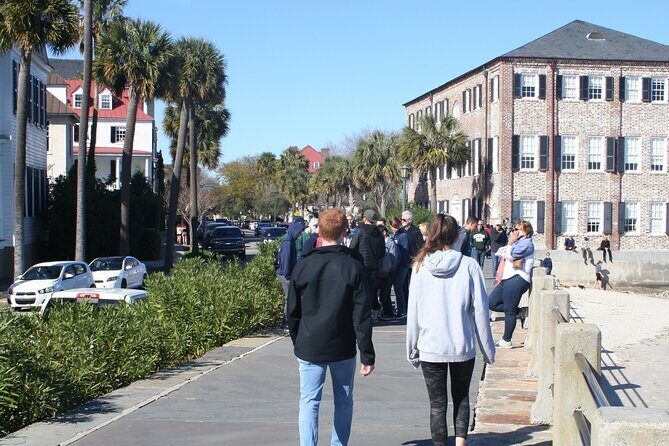
Your tour begins at 108 Meeting St. This is one of those Charleston “good starting points” where you can naturally expand into other stops after the walk ends. Since the tour finishes in a different location (they’ll share the details), you’ll want to keep some flexibility. It’s not a full loop back to the door you started at, so plan a nearby lunch or your next activity accordingly.
If you’re arriving by public transportation, the meeting point is described as near it. And if you’re bringing a service animal, service animals are allowed, which makes this feel more traveler-friendly than some walking tours that act like assistance doesn’t exist.
Old Exchange and Provost (1771): The Port That Held Power
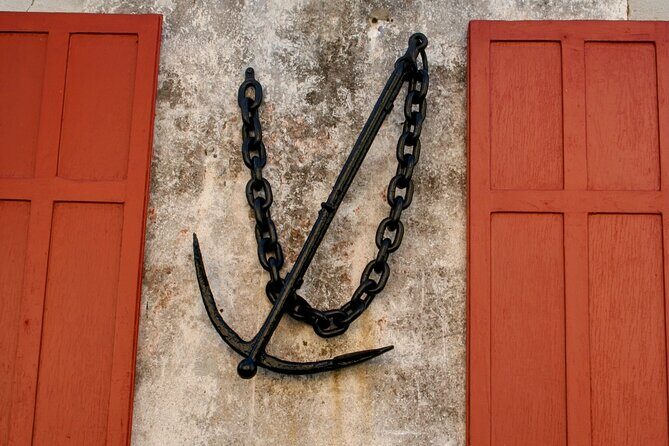
Stop one is 122 E Bay St, at the Old Exchange and Provost. This building was designed to collect tariffs and fees at the port. That detail alone tells you Charleston wasn’t just a pretty shoreline—it was a trading engine, and the people running it needed places like this to enforce and manage commerce.
What makes this stop memorable is how often the building changes roles in a short slice of time:
- South Carolina declared independence here in 1776
- The British used it as a prison (1780–1782)
- The Constitution was ratified here
- President George Washington was entertained in 1791
That’s not a random history checklist. The point for you is to see how one physical place can hold completely different kinds of power—government, conflict, and ceremony—without changing its walls much.
Time-wise, you’ll get about 7 minutes. That’s enough to understand why it mattered, but it won’t replace a longer inside visit if you’re the type who likes to linger.
Rainbow Row: Preservation as an Idea, Not Just a Photo
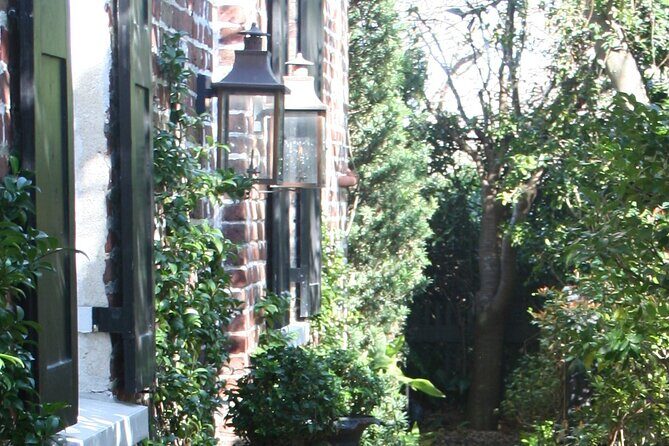
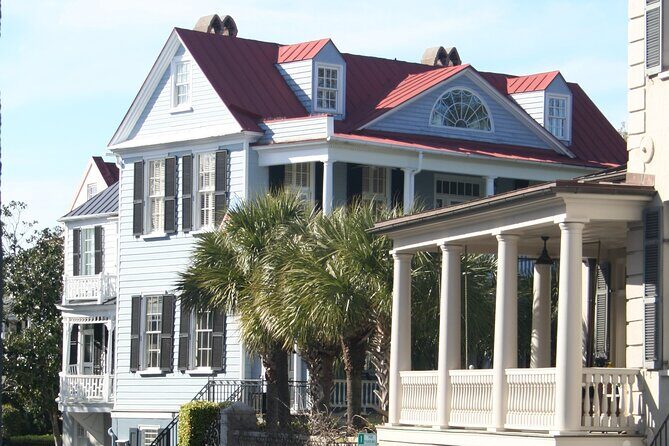
Next is Rainbow Row, 18th-century buildings in Georgian and Jacobean styles facing the harbor. The harbor view matters. These structures weren’t built as background scenery—they were tied to daily life near the water.
What I like about how this stop is framed is the preservation angle. In the 1930s, the “dilapidated” buildings were restored into residences. They call it perhaps the first successful venture in Charleston’s early preservation movement.
So here’s the takeaway: you’re not just seeing a famous street. You’re seeing an early lesson in what happens when a city decides its past is worth saving. If you’ve ever wondered why Charleston looks the way it does today, this is one of the answers.
This is a shorter 5-minute stop. Go ahead and take the photos, but don’t miss the historical point.




St. Michael’s Church (1761): Tiffany Glass and Atlantic-Bound Bells
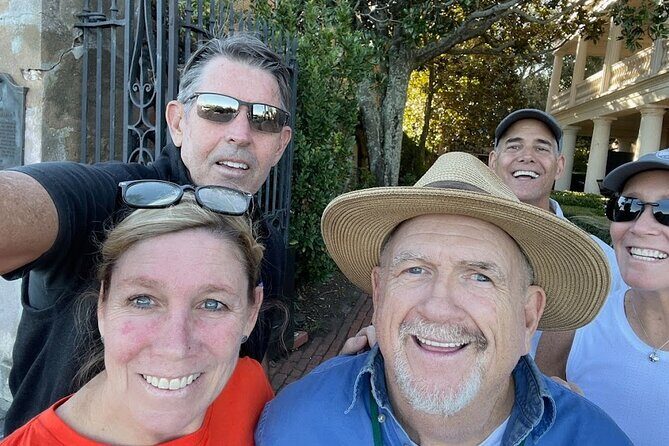
Stop three brings you to St. Michael’s Church, described as Charleston’s oldest church and built in 1761. It’s substantially intact to its 18th-century design, which makes it feel more grounded than a lot of “historic” sites that are restored into something new.
Two details stand out for me:
- Some windows include stained glass by Louis Tiffany and Company
- The graveyard includes two signers of the Constitution
And then there’s the bell story: the church bells have crossed the Atlantic Ocean five times. You might not catch the full bell story in one quick explanation, but it adds a sense of Charleston as a place connected to wider worlds, not isolated behind its own charm.
Plan for about 8 minutes here. If you’re a slow reader who wants to stand and stare, you’ll likely wish you had more time—but the guide can at least get you oriented so you enjoy what time you do have.
Dock Street Theater: When Old Ground Gets a Second Life
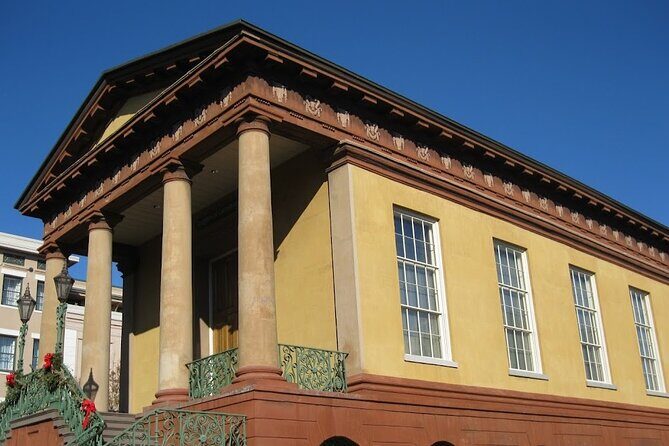
At Dock Street Theater, you’ll learn about a clever connection between eras. In 1937, the Work Projects Administration created a playhouse in the style of the 18th century. But the key point is that research found the first dedicated theater space in British North America was built on the same ground in 1736.
So this stop is about continuity. A city can reinvent a place without completely losing its original identity. For you, that means you’ll likely “see” more than just a building—you’ll notice how Charleston layers time.
The stop is about 10 minutes. That works because the concept is big, but the walk-by conversation keeps it tight.
St. Philip’s Church: Deep Roots from 1680
Stop five is St. Philip’s Church, the oldest congregation, founded in 1680. This church’s graveyard includes national figures, including a signer of the Declaration of Independence and a signer of the Constitution.
The continuity detail is also strong: St. Philip’s has worshiped at this sight since 1723. That long stretch of use is what helps historic buildings feel less like museum props and more like places with an ongoing life.
You’ll get about 10 minutes. If churches aren’t your thing, this one still earns time because it’s a place where the big names in early American history are tied to actual stone and actual ground—not just a chapter heading.
Circular Congregational Church: The Quiet Power of Slate Tombstones
Next is Circular Congregational Church. This congregation has worshiped at the same site since 1681. The notable visual here is the fine slate tombstones from the 18th century.
Circular buildings always make me slow down a little, and this stop is designed to do that for you. It’s a chance to see another kind of Charleston memory: not just civic buildings and famous views, but the local, enduring religious community.
This stop runs about 15 minutes, which is longer than several others. That extra time is likely there for you to actually take in what you came for.
Powder Magazine (1713): Fortified Storage with a Big Engineering Idea
Stop seven is the Powder Magazine, built in 1713 to house gunpowder. It’s described as the oldest public-use structure between St Augustine and Williamsburg. That’s a long geographic span, so it’s a real “this matters” clue.
A short 5 minutes here might feel brief, but it’s enough to understand the purpose: this is not a decorative historic stop. It’s a piece of military logistics.
If you’re the type who loves the practical side of history, this kind of stop is a nice break from the more emotional stories of prisons and graves.
Nathaniel Russell House: Federal-Era Elegance and a Designed Garden
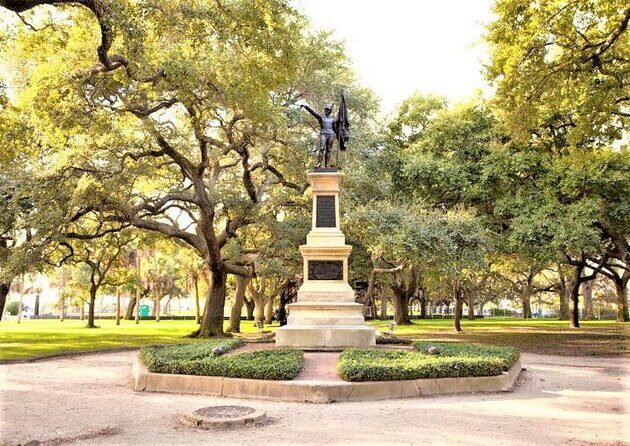
Stop eight is at the Nathaniel Russell House. You’ll walk through the garden, designed by landscape architect Loutrell Briggs—and here, the point is design as status. This wasn’t a “small home.” It’s noted as perhaps the finest Adams/Federal style house available to tour in the country.
I like this stop because it shifts the tone. The earlier stops emphasize institutions and faith. This one shows you what success looked like when it was built into architecture and outdoor layout.
It’s about 10 minutes. Again, it won’t replace a longer interior tour, but it sets you up to see why the house is so talked about.
Battery and White Point Gardens: Waterfront Drama You Can See
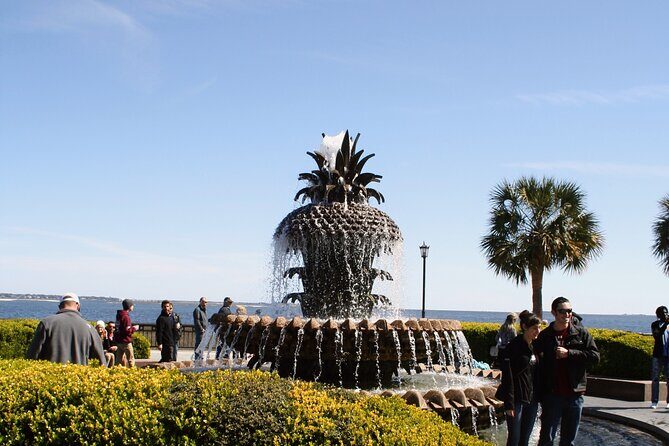
Stop nine brings you to Battery & White Point Gardens, Charleston’s historic waterfront. Here the conversation turns to conflict and geography.
You’ll talk about:
- The Battle of Fort Sumter (1861)
- The Battle of Fort Sullivan (1776)
Then you get the pre-Civil War social angle: grand waterfront homes built as party palaces for winter seasons.
This is also where your eyes do more work than your ears. Waterfront history makes sense because you can connect the story to the water and the view in front of you.
This stop is about 15 minutes, which is a good amount of time for both explanation and looking around.
The Gibbes: Southern Art Since 1858
After the waterfront comes an art stop: the Gibbes. It has been procuring Southern Art since 1858, and the collection includes miniature and full-length portraits from the 18th and 19th centuries.
This is a useful contrast. If your brain is already packed with dates and churches, portraits can help you understand the people behind the history—at least the way they wanted to be remembered.
How much time you get here isn’t listed, but you’ll still walk away with at least one specific thing to remember: Southern art collecting with a long timeline.
Pink House Gallery: Entertainment with a Name You Can Believe
Stop ten is the Pink House Gallery, described as Charleston’s oldest surviving entertainment venue. It originally started as a tavern, and some sources date it as early as 1686.
The fun detail is the origin of the name: it’s not because someone painted it pink. It’s named for boldly pink coral rock.
That kind of trivia is more than trivia—it makes the building feel physical and specific. And it’s the sort of story you’ll enjoy repeating later when someone asks why Charleston looks the way it does.
This stop runs about 5 minutes.
Powder Magazine Again: The Brutal Physics of Gunpowder Storage
The tour includes the Powder Magazine again with a more detailed engineering explanation. This section focuses on the idea that the building was built specifically for gunpowder storage.
You’ll hear some striking details:
- The walls are 35 inches thick in brick
- The vaulted ceilings are designed so they are just two bricks thick at the top
- The design is intended so that, if exposed, it blows up rather than outward
- The Colonial Military Museum has been operated by the Colonial Dames since 1905
This is where the “history walking tour” becomes “history you can picture.” Even if you don’t memorize the measurements, you’ll understand the mindset: risk management was built into the architecture.
This stop is about 5 minutes. Short, but memorable because it’s so practical.
How Much Walking Is This, Really?
This is a walking tour, but the route timing suggests it’s meant to be steady rather than punishing. You’ll hit a sequence of stops with short durations—many around 5 to 10 minutes, a couple longer—so the whole experience is structured for flow.
For people using wheelchairs or strollers, the tour is described as accessible. That’s a big deal in Charleston, where some streets and sidewalks can be uneven. If you’re bringing mobility support, I’d still wear shoes that can handle curbs and watch your pace on busy sidewalks.
Also, plan for sun and water. Lunch isn’t included, and there’s no mention of a planned break.
Who This Tour Is Best For
This tour is a strong fit if you want:
- A guided way to connect major Charleston landmarks in a short time
- A history story told in layers: port power, independence-era shifts, religious roots, and waterfront conflict
- A stop list that mixes architecture, churches, art, and entertainment venues
You’ll likely enjoy it most if you like walking tours and want someone to translate what you see into meaning fast. It’s also a good choice for couples and small groups who can keep up at a normal city pace.
If you’re the type who loves long museum time, you may want to pair this with additional self-guided visits after. The tour is built for getting your bearings and building context, not for replacing an all-day museum plan.
Should You Book Charleston Footprints Walking Tour?
Yes, I think it’s a good buy if you want a guided history walk that stays practical and grounded in what you can actually see. The price is reasonable for the amount of time on the street, and the fact that multiple stops are listed as free admission tickets helps the value feel more real.
Two reasons I’d especially consider booking:
- The guides are repeatedly described as entertaining and good at answering questions, with named examples like Al and Eric showing up in the experiences.
- The mix of stops—from Old Exchange and Provost to St. Michael’s, then waterfront and art—keeps the story from becoming one-note.
Just do one thing that keeps your day smooth: keep your confirmation handy and double-check the day-of. With any popular walking tour, a quick check prevents stress.
FAQ
How long is the Charleston Footprints Walking Tour?
It runs about 2 hours to 2 hours 15 minutes.
How much does it cost?
The price is $28.50 per person.
Where does the tour start, and where does it end?
The tour starts at 108 Meeting St, Charleston, SC 29401. It ends in a different location, and you’ll be given the end-location details.
Is the tour limited to a small group?
Yes. The tour has a maximum of 20 travelers.
Is it wheelchair and stroller accessible?
Yes. The tour is described as wheelchair and stroller accessible.
Is a mobile ticket provided?
Yes, it uses a mobile ticket.
What language is the tour offered in?
The tour is offered in English.
Does the tour include lunch or alcoholic beverages?
Lunch is not included. Alcoholic beverages are noted as strictly for 18 years old and above only.
What if weather is bad?
This experience requires good weather. If it’s canceled due to poor weather, you’ll be offered a different date or a full refund.