REVIEW · CHARLESTON
Charleston Chicora 2 Hours Walking Tour
Book on Viator →Operated by JWalk Tours · Bookable on Viator
One good walk can set your whole trip. Charleston Chicora strings together iconic churches, famous streetscapes, and two buildings tied to Charleston’s darker past, all in about two hours. It’s built for speed without feeling rushed, and it even teaches small details like the difference between a graveyard and a cemetery.
I especially like the way the route balances landmark photo stops with stories you can’t easily read on your own. I also like that Jonathan (JWalk Tours) keeps the pace light, with lots of room for questions and a conversational style that makes the city feel human.
The main thing to plan for is that a few stops are not included in the price, and you’ll want to budget extra admission plus bring water for the walk.
In This Review
- Key Things to Know Before You Go
- Why This Two-Hour Walk Works in Charleston
- Getting Started on Church Street at Bitty and Beau’s
- St. Philip’s Church: Where the Lesson Starts
- French Huguenot Church: A Specific Kind of Faith
- Dock Street Theater: The Stage Built for Performance
- The Pink House Gallery: Old Buildings, Quick Hits
- Old Slave Mart Museum: Facing the Hard Part
- Old Exchange & Provost Dungeon: Power in Stone
- Rainbow Row: The Iconic Photo Stop (With Context)
- Nathaniel Russell House: One of Charleston’s Old Mansions
- St. Michael’s, Circular Congregational, and The Powder Magazine
- Timing, Walking Pace, and Comfort Tips That Actually Matter
- Price and Value: Why $40 Is (Usually) a Good Deal
- Who Should Book This Walk (and Who Might Skip It)
- Should You Book Charleston Chicora?
- FAQ
- How long is the Charleston Chicora walking tour?
- Where does the tour start?
- What language is the tour offered in?
- Are tickets included for all stops?
- What should I know about weather?
- Is the tour physically demanding?
- Are service animals allowed?
Key Things to Know Before You Go
- Jonathan of JWalk Tours leads with lively, story-driven commentary and a friendly, interactive feel
- Two hours, tight route helps you cover big Charleston highlights even on a short schedule
- Most stops are free, but a handful have admissions that are not included
- Hard-history stops are part of the walk, including the Old Slave Mart Museum and the Provost Dungeon
- Outdoor walking + moderate fitness means you should bring water and wear comfy shoes
- Max 20 people keeps the group manageable and the tour feeling more personal
Why This Two-Hour Walk Works in Charleston
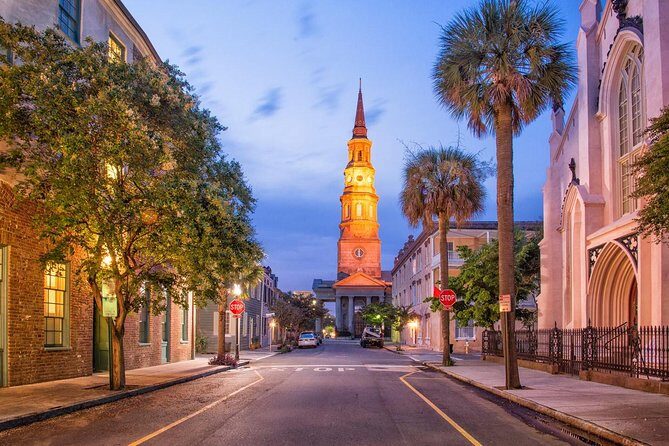
Charleston can be overwhelming fast. This tour is designed for the opposite problem: too little time. You get a concentrated sweep of major sites in about two hours, so you leave with a strong mental map of where things are and why they matter.
What makes it work is the mix of settings. You’re not only looking at pretty buildings. You’re also getting context for how Charleston grew, who benefited, and what the city did with power—good and bad—over time.
The route also includes multiple quick stops, which is great if you’d rather keep moving than sit through long explanations. Even the shorter moments are meaningful, because the guide connects them with the bigger story.
Other walking tours we've reviewed in Charleston



Getting Started on Church Street at Bitty and Beau’s
You meet at Bitty and Beau’s Coffee, 159 Church St, Charleston, SC 29401. The start time is 10:00 am, and the tour ends back at the meeting point, so you’re not left figuring out transportation or timing afterward.
This location is practical. Church Street is easy to reach and easy to anchor your day to, especially if you plan to continue walking or grab lunch on your own after the tour.
Because it’s a walking tour, plan to arrive with your comfort basics ready. Closed-toe shoes help, and bring water—especially if it’s warm, humid, or sunny.
St. Philip’s Church: Where the Lesson Starts
The first stop is St. Philip’s Church. It’s tied to the oldest congregation in Charleston, and it’s one of the most iconic church stops in the city. You’ll also spend time with its graveyard and cemetery, and you’ll learn the difference between the two.
That detail sounds small, but it changes how you read the churchyard. Instead of seeing name stones and dates as decoration, you understand what you’re looking at and why it was set up that way. It’s also a good opener because the setting makes the guide’s stories feel grounded.
One practical note: church-and-yard stops can be uneven underfoot. Shoes matter more than you think for this part of Charleston.
French Huguenot Church: A Specific Kind of Faith
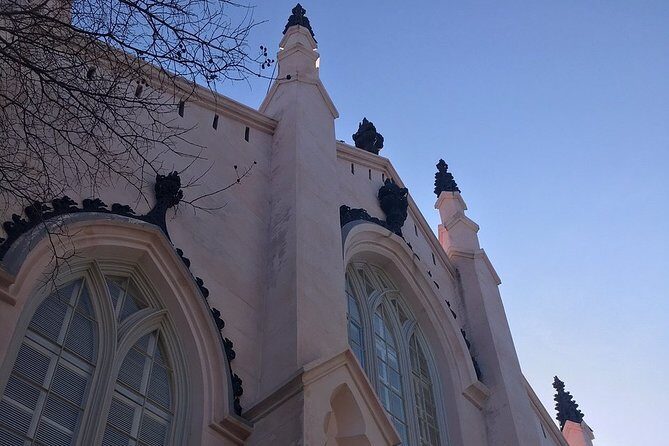
Next up is the French Huguenot Church. The standout fact here is that it’s described as the only Calvinist French Huguenot church in the Western Hemisphere. You’re also looking at a gothic-style church with a history that gives the area more texture than the common postcard version of Charleston.
If you like your architecture with context, this stop hits a sweet spot. It’s not just pretty stone; it’s tied to a community story and the way different groups shaped the city.
This is also a quick stop, which helps keep the schedule tight. You get to see the place and understand its significance without losing time.
Dock Street Theater: The Stage Built for Performance

After the churches, you move to Dock Street Theater. This site is noted as the first building in North America built for the sole purpose of theatrical productions.
That matters because you’re not only seeing a theater. You’re seeing a statement about culture and public life—how Charleston made space for performance as a function, not an afterthought.
If you care about how cities plan for arts, this stop gives you a useful angle. It also serves as a mental palate cleanser before you head toward the more serious history ahead.
If you're still narrowing it down, here are other tours in Charleston we've reviewed




The Pink House Gallery: Old Buildings, Quick Hits
Then there’s the Pink House Gallery, described as the second oldest house in Charleston. The tour frames it as a quick look, which makes sense on a schedule like this. In a single visit, you can’t inventory everything old in Charleston, so you pick key anchors—and this is one of them.
The value here is learning how “small” buildings fit into the bigger city picture. Charleston isn’t only churches and big mansions. It’s also domestic structures that tell you about how everyday life could look in an earlier era.
Old Slave Mart Museum: Facing the Hard Part

The emotional center of the walk comes with Old Slave Mart Museum, a slave market from 1856. This stop is where the tour addresses the dark history of slavery and Charleston’s role in it.
I appreciate that this isn’t treated as a quick photo op. Even with a short time window, the guide’s focus is on context and clear framing. It gives you a chance to understand what happened in a specific place, not just in a general textbook way.
A practical consideration: this stop is not included in the price. Plan for the admission cost separately so you don’t get surprised mid-route.
Old Exchange & Provost Dungeon: Power in Stone
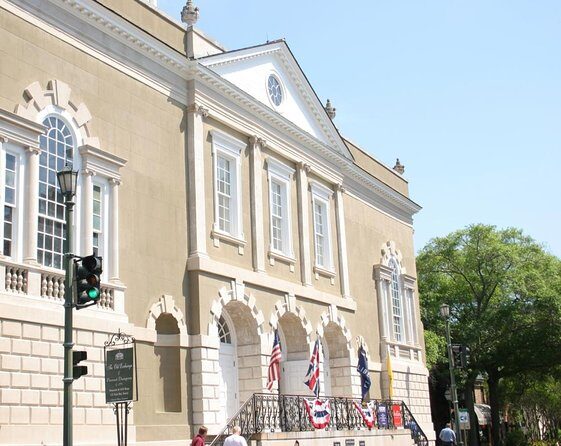
Another major stop is Old Exchange & Provost Dungeon. It’s described as one of the most historical buildings in the country, and it ties strongly to the mechanisms of authority—how people were managed, punished, or controlled.
This is the kind of place where architecture helps you feel what the guide is describing. Even if you only know Charleston as a charming destination, these spaces remind you that the city’s beauty and its power systems were linked.
Like the Old Slave Mart Museum, this stop has admission not included. It’s worth planning for extra cost and a little extra mental heaviness so you’re ready for what the space represents.
Rainbow Row: The Iconic Photo Stop (With Context)
Then you hit Rainbow Row, one of Charleston’s most iconic streetscapes. This is your lighter, visual break—there’s a clear chance for photos, and the color and symmetry do their job.
But if you only think of Rainbow Row as cute, you miss the point. On this tour, it’s part of the story of what Charleston chose to preserve, highlight, and rebuild over time.
This stop is also quick, which is ideal. You get the best part—seeing it and snapping photos—without turning your day into a long detour.
Nathaniel Russell House: One of Charleston’s Old Mansions
Next is the Nathaniel Russell House, described as one of the oldest and most historic mansions in Charleston. This is a strong stop for architecture lovers and for anyone who wants to see how wealth and design showed up in real daily life.
But here’s the trade-off: admission not included. If you want to go inside or spend time longer than the scheduled brief, you’ll need extra planning and money. If you’re short on time, you can still appreciate what you see from the outside while you listen.
St. Michael’s, Circular Congregational, and The Powder Magazine
The walk closes with a set of stops that each adds a different type of meaning.
- St. Michael’s Church is described as the oldest church in Charleston. This is a quick stop, but it’s a powerful one if you like tracing early roots through place names and institutions.
- Circular Congregational Church ties to the oldest graveyard in Charleston. It’s another reminder that the city’s identity is written into its burial grounds and community structures.
- The Powder Magazine is noted as the oldest municipal building in Charleston. You get a glimpse of how Charleston functioned as a city, not only a collection of pretty streets.
For the Powder Magazine, admission is not included. So again, plan for optional costs depending on what you want to see closely.
Timing, Walking Pace, and Comfort Tips That Actually Matter
This tour is about two hours, with the total walk broken into short stops. That’s the smart way to do Charleston, because the distances between major sites are manageable, and the schedule keeps you from burning out.
Still, it’s not a sit-and-sip tour. You should have moderate physical fitness, wear comfortable shoes, and expect an outdoor walking experience.
Also, because it runs in good-weather conditions, plan to be flexible. If it’s not a weather day, you’ll need an alternate date or refund depending on how it’s handled.
Price and Value: Why $40 Is (Usually) a Good Deal
At $40 per person for about two hours, the value comes from three things:
First, you’re paying for a guide who connects architecture to lived events. That’s what turns a pile of buildings into a story you can remember.
Second, many stops are set up as quick points of interest, which means you spend time learning rather than searching. That’s especially useful if it’s your first day and you want to get your bearings fast.
Third, the route includes multiple free-entry viewing stops, and you only pay admission at a few major sites that carry the most weight. The catch is you should treat extra admissions as part of your budget.
In other words: the $40 price is a fair base fare, but you should expect to pay additional ticket prices for Old Slave Mart Museum, Old Exchange & Provost Dungeon, Nathaniel Russell House, and The Powder Magazine.
Who Should Book This Walk (and Who Might Skip It)
This is a strong fit if you want:
- a first-time Charleston overview
- a short itinerary with major landmarks
- a guide who explains small distinctions and larger context in plain language
- a route that includes hard history, not just pretty streets
You might consider a different option if you prefer long museum time or you want a tour that stays mostly inside with minimal walking. Since the schedule is built on quick stops, this is less about deep, hour-long exhibits and more about learning the city’s structure fast.
Group size is limited to a maximum of 20 travelers, which helps keep the experience from feeling like a cattle-line bus tour. If you like asking questions, that smaller feel can matter.
Should You Book Charleston Chicora?
If you’re doing Charleston in a limited window, I think this is worth booking. You cover the “big map” sites and the sites tied to the city’s hardest chapters, and you do it in a format that keeps you moving without losing meaning.
Also, the style matters here. The guide is described as personable, engaging, and strongly invested in the city. That comes through in the pacing: you get stories, not just facts, and you get enough interaction to keep the walk from feeling one-directional.
Just go in knowing two things: bring water, and save a little extra budget for the admission-required stops. If you do that, you’ll leave with Charleston clearly organized in your head, not just photographed on your phone.
FAQ
How long is the Charleston Chicora walking tour?
The tour lasts about 2 hours.
Where does the tour start?
It starts at Bitty and Beau’s Coffee, 159 Church St, Charleston, SC 29401 and ends back at the meeting point.
What language is the tour offered in?
The tour is offered in English.
Are tickets included for all stops?
Not all stops are included. Admission is not included for Old Slave Mart Museum, Old Exchange & Provost Dungeon, Nathaniel Russell House, and The Powder Magazine.
What should I know about weather?
This experience requires good weather. If it’s canceled due to poor weather, you’ll be offered a different date or a full refund.
Is the tour physically demanding?
You should have moderate physical fitness since it’s a walking tour.
Are service animals allowed?
Yes. Service animals are allowed.
If you want, tell me your travel dates and whether you prefer more church/architecture or more museum time, and I’ll help you decide if this is the right first-day walk or better saved for later.