REVIEW · CHARLESTON
Pirate Escape Charleston Scavenger Hunt and Free Museum
Book on Viator →Operated by Native Charleston Tours · Bookable on Viator
Pirates, clues, and Charleston all in one walk. This self-guided escape game is built around the real 1718 Pirate Siege of Charles Town, plus it kicks off with free entry to a major historic stop. What I like most: you get practical direction in an easy walking format, and you also pass by standout landmarks you might skip on a standard downtown stroll. One thing to consider: it is still a hunt, so you have to slow down, read instructions, and search a bit, not just sightsee.
Two details make it especially appealing for families and active couples. First, the route keeps to the historic district and covers about a mile and a half at your own pace. Second, the museum start point is the Powder Magazine, described as the oldest fireproof building in the United States. The pirate theme and the built-in “escape” goal are fun, but the length and the historic focus land best for kids 10+.
In This Review
- Key points to know before you go
- Pirate Escape Charleston: the idea that makes it work
- Price and value: why $9 feels like a steal
- Where you start at 100 Meeting St (and how you stay on track)
- The 1.5-mile pirate route: what each stop teaches you
- Stop 1: The Powder Magazine (the big start)
- Stop 2: St. Philip’s Church (architecture you can feel)
- Stop 3: Philadelphia Alley (the kind of place you might miss)
- Stop 4: Pink House Gallery (a colorful, memorable break)
- Stop 5: Old Exchange & Provost Dungeon (history with weight)
- Stop 6: Battery & White Point Gardens (finish with an open-air view)
- Self-guided means you control the pace (and the effort)
- Who this is best for (and who might want a different style)
- The history angle: pirate fun, but with real grounding
- Practical tips that make the hunt smoother
- Should you book Pirate Escape Charleston?
- FAQ
- How long does Pirate Escape Charleston take?
- Is the scavenger hunt self-guided?
- What’s included at the start of the experience?
- Where does the experience start and end?
- What language is the experience offered in?
- Do you need a paper ticket?
Key points to know before you go

- Powder Magazine is included: free entrance to start the scavenger hunt
- A real 1718 story drives the clues, tied to the Pirate Siege of Charles Town
- About 1.5 miles in the historic district keeps it manageable but still active
- Self-guided by packet instructions means you control your pace and breaks
- Stop sequence hits big Charleston icons like St. Philip’s Church and the Old Exchange
Pirate Escape Charleston: the idea that makes it work
Charleston can be a little tricky for visitors because the city is so photogenic that it tempts you to wander fast and miss details. This scavenger hunt flips that. You still walk through the same gorgeous streets, but the prompts make you look closer—at small objects, layouts, and the way buildings and alleys shape movement through town.
The theme is pirate escape, but the engine is history. The hunt is centered on the Pirate Siege of Charles Town in 1718, and the stops line up with locations you can connect to that era. Even if you are not a pirate-history person, the packet-style instructions help you understand what you are seeing while you move.
And the value is hard to ignore: it is priced at $9 per person and includes free museum admission at the start. When you factor in that museum ticket would cost extra on a separate visit, the hunt starts to feel like a low-cost way to get a guided-looking experience without paying for a full tour guide.
Other museum experiences in Charleston



Price and value: why $9 feels like a steal

At $9 per person for roughly 1.5 miles of walking and an included museum entry, the pricing structure is clearly meant to be accessible. You are not paying for a group bus, a long sit-down lecture, or a live guide following you minute by minute. Instead, you pay for a smart set of instructions and a route that strings together major points in Charleston’s historic district.
The biggest value piece is the Powder Magazine entry. The experience description calls it the oldest fireproof building in the United States, which means you are getting more than a quick exterior glance. You start with access to a key historic site, then continue with additional landmark stops.
If you like guided direction but want flexibility, this model fits. You can pause, take photos, and move at a comfortable pace—then finish within the recommended time window to complete the escape goal.
Where you start at 100 Meeting St (and how you stay on track)
The walk begins at 100 Meeting St, Charleston, SC 29401 and ends back at that same location. That matters more than it sounds. Charleston’s historic district is compact, and starting and ending in the same place reduces the stress of figuring out navigation at the end.
You also receive a mobile ticket, and the team sends meeting location instructions by text about an hour before the start time (so you’ll want to book with a valid phone number). From there, you pick up an instruction packet at the start location and follow it stop by stop.
Because it is self-guided, your “guide” is the packet. That is a plus for many people, but it also means you are responsible for reading the directions and not skipping ahead. One review specifically warned to not jump too far forward, which is good advice. Follow the packet order so the clues and tasks make sense in context.
The 1.5-mile pirate route: what each stop teaches you
This route moves through six major stops that, taken together, tell a story of Charleston’s historic built environment. It is not a museum crawl with long indoor stays. It is more like a structured walking puzzle through the city.
Stop 1: The Powder Magazine (the big start)
You begin at the Powder Magazine, and that is the clever part of the whole experience. It sets the tone with real history before you even start the “escape” tasks.
The experience description highlights that the Powder Magazine is the oldest fireproof building in the United States. That single line is a reminder that you are not just playing a game—you are stepping into a building made for safety and storage in a period when fire risk was serious.
A practical note: because it is part museum entry plus active clue-finding, it’s worth wearing comfy shoes. The overall walk is only about 1.5 miles, but the time adds up when you stop often.






Stop 2: St. Philip’s Church (architecture you can feel)
Next you head to St. Philip’s Church. Even if you have seen photos of Charleston churches, being in front of the real thing during a hunt changes how you look. You tend to notice details you would otherwise ignore, because the packet is guiding your attention.
For families, this kind of stop helps keep kids engaged. One review called out that messages in the hunt can be humorous and encouraging, which helps when a walk includes historic places that might feel serious.
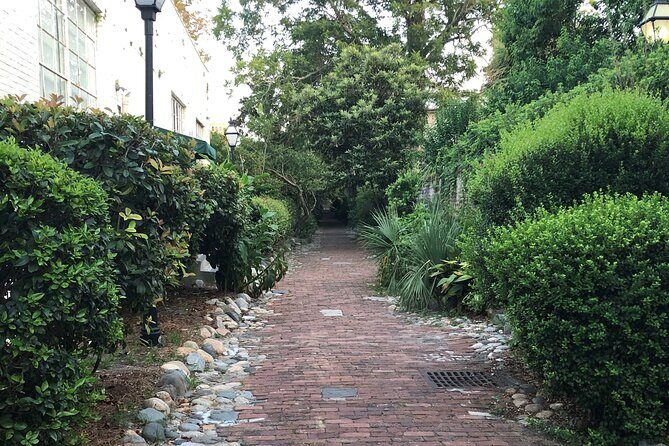
Stop 3: Philadelphia Alley (the kind of place you might miss)
The hunt then takes you down Philadelphia Alley. This is the type of street Charleston is famous for, but it is also the type of alley you might walk past if you are just moving from one big landmark to another.
In scavenger-hunt mode, you slow down. You notice the narrowness, the turning points, and the “hidden by design” feeling of these passages. That is exactly why alleys matter in a story-based route. They show you how people moved and how parts of the city could feel secluded.
Stop 4: Pink House Gallery (a colorful, memorable break)
Then comes Pink House Gallery. It’s a visually distinctive stop, and that helps you keep momentum. The hunt format works best when there are anchor points you remember, and this is one of them.
If you are traveling with kids, this is likely where you get the easiest buy-in. Bright, unusual buildings make it simple to participate, even if the pirate story isn’t your main interest.
Stop 5: Old Exchange & Provost Dungeon (history with weight)
Next up is Old Exchange & Provost Dungeon. This is a heavier site in tone than the brighter stops, and that contrast is part of what makes the whole route feel like a real walk through time rather than a checklist.
This kind of stop also benefits from careful reading in the packet. The experience description says the historical accuracy of the designated sites and information was vetted by two local historians and the museum director. That means your clues are meant to connect to real context, not just generic pirate vibes.
Stop 6: Battery & White Point Gardens (finish with an open-air view)
Finally, you reach Battery & White Point Gardens. Ending with a more open, scenic area is smart for two reasons. One, it gives your legs a breather after tighter streets. Two, it helps you end on a sense of place, not just on another landmark name.
Even though the total distance is manageable, expect a lot of short stops and clue-checking. You can finish in the recommended time, complete the escape goal, and then soak in a bit of the final views without feeling rushed.
Self-guided means you control the pace (and the effort)
This is self-guided, private, and designed around your group only. That’s important because it keeps the experience from feeling like a big group tour where everyone waits.
For many people, self-guided is the ideal format in Charleston. The city rewards slow looking. You can stop to read, take photos, or use breaks for water. One couple review summed it up as fun scavenging with a learning focus—just remember you are walking.
The other side of self-guided: you do not get a live guide walking beside you. One lower rating pointed out that the crew could offer more direction. The reply to that concern emphasized that it is advertised as self-guided, reflected in the low price, and that help is available.
Here’s how to make it work smoothly: read the packet instructions at the start, and when you think you are stuck, use the communication method built into the experience. The team has a creator on standby, and one review mentioned you can text photo updates to help document finds. That same system also supports quick answers during the route.
Who this is best for (and who might want a different style)
This hunt is great for families, couples, and solo walkers who like interactive sightseeing. The experience description says it is great for children, but also adds that it is best received by those 10+ years old because of the length and the historic basis.
So I’d match it like this:
- If your kids are curious and okay walking and reading, this is a fun way to get them to participate.
- If your group enjoys history but hates boring lectures, the pirate escape format makes the learning feel lighter.
- If you want zero mental effort and only landmarks, this is probably not the best fit. You will need to follow directions and hunt for items.
The history angle: pirate fun, but with real grounding
The pirate siege theme could easily turn into pure fantasy, but the experience is set up to stay tied to reality. The clue package focuses on the 1718 Pirate Siege of Charles Town, and the designated sites are described as vetted by local historians and the museum director.
That matters because it gives you a “why” behind what you see. When you reach a church, an alley, or the dungeon, you aren’t just collecting points—you’re connecting the physical places to a real historical moment.
It also helps explain why the format is recommended for older kids and adults. Younger kids might still enjoy the pirate theme, but the history-heavy nature means they’ll get more out of it with enough attention span for context.
Practical tips that make the hunt smoother
A few small details can make a big difference with a self-guided scavenger walk:
- Wear shoes you can walk in for a solid stretch. The total distance is about 1.5 miles, but clue stops stack up.
- Keep your packet in hand and don’t skip far ahead. Follow the intended order so tasks line up.
- Plan to be present at each stop instead of speed-walking. The “escape” depends on doing the required searching.
- Use the photo text updates if you want documentation and faster help when needed.
One review also mentioned they wanted a certificate or sticker at the end. That is not described as part of the experience, but it’s a good reminder to treat it as an experience first, not a souvenir event.
Should you book Pirate Escape Charleston?
I’d book it if you want an affordable, interactive way to see Charleston’s historic district while getting museum access at the same time. The combination of the Powder Magazine start, the structured route through major landmarks, and the pirate escape theme makes it feel more engaging than a simple walk.
Skip it if you want a fully guided, low-effort tour. Since it is self-guided, you’ll do better if you are happy to read instructions and search for answers. And if your group includes younger kids, aim for ages where they can handle both walking and a history-based packet.
If you want a playful challenge that still respects history—and you’re willing to put on comfortable shoes—it’s an easy yes.
FAQ
How long does Pirate Escape Charleston take?
It takes about 1 hour 30 minutes on average.
Is the scavenger hunt self-guided?
Yes. You follow the instructions in a packet, and you walk the route at your own pace.
What’s included at the start of the experience?
You get free entrance to the Powder Magazine, described as the oldest fireproof building in the United States.
Where does the experience start and end?
It starts at 100 Meeting St, Charleston, SC 29401, and it ends back at the same meeting point.
What language is the experience offered in?
The experience is offered in English.
Do you need a paper ticket?
No. You receive a mobile ticket.