REVIEW · CHARLESTON
Historic Charleston Walking & Storytelling Tour
Book on Viator →Operated by Holy City History Tours · Bookable on Viator
Charleston stories land better on foot. This walk strings together colonial Charleston and American Revolution moments with real street-level details, plus you’ll also get indoor time with included admissions to the Philip Simmons House and Halsey Gallery. I love how the guide turns architecture and place names into a narrative you can actually follow, and I also love the payoff: harbor views from White Point Garden that make the city feel big, not just historic.
My main caution is simple: you’re walking for about two hours, and summer sun can be intense. Even if there’s some shade, plan like it will be hot—bring sunscreen, a hat, and a bottle of cold water.
In This Review
- Key highlights at a glance
- Why this Charleston storytelling walk fits your schedule
- Old Exchange and Provost Dungeon: where trade meets punishment
- Rainbow Row on East Bay Street: the longest Georgian row in the U.S.
- A Charleston single house on Fort Mechanic ruins: engineering before elegance
- White Point Garden and the Battery: harbor views with a defensive purpose
- Nathaniel Russell House at 51 Meeting Street: neoclassicism with heavy context
- The Four Corners of Law: one intersection, four institutions
- How the guide keeps the story moving (and tailored)
- Price and value: why $35.90 makes sense for what you get
- Smart packing for Charleston walking days
- Should you book this Charleston walking and storytelling tour?
- FAQ
- Where does the tour start?
- How long is the Historic Charleston Walking and Storytelling Tour?
- How much does the tour cost?
- Is the tour offered in English?
- Do I get a mobile ticket?
- What’s included besides outdoor sightseeing?
- How large is the group?
- Is the tour suitable for most people?
- What happens if poor weather cancels the tour?
- How far in advance can I cancel for a full refund?
Key highlights at a glance
- Small-group feel (max 20 people) so you can hear the stories without shouting.
- Included indoor admissions to the Philip Simmons House and Halsey Gallery.
- Big-picture Charleston themes like trade, defense, and how the past keeps showing up.
- View stop at White Point Garden with easy access to the Battery area.
- Architectural stops with clear time periods from 1700s to the 1800s and beyond.
- Meeting & Broad Street landmark cluster known as the Four Corners of Law.
Why this Charleston storytelling walk fits your schedule
If you have limited time in town, this tour is a smart use of it. It runs about two hours, starts at 122 E Bay St, and ends back at the meeting point, so you’re not stuck figuring out where to go next.
The format is built for normal people. You’ll do a walking loop through major sights, with frequent story connections that help everything click. The tour is offered in English, uses a mobile ticket, and keeps group size to a maximum of 20, which matters in a city where so much can feel crowded.
Also, plan for popularity. On average, this is booked about 9 days in advance, so if your dates are tight, I’d reserve sooner rather than later.
Who I think should book it: first-time Charleston visitors, history lovers who want more than a checklist, couples who like guided wandering, and families who need entertainment mixed in with facts. If you’re already a Charleston history expert, you’ll still get value from the way the guide shapes the route and emphasizes what to notice in each building and street.
Other historical tours in Charleston



Old Exchange and Provost Dungeon: where trade meets punishment
The walk kicks off at a building that’s been part of Charleston’s identity for nearly 250 years. The Old Exchange and Provost Dungeon started in 1771 as a commercial exchange and custom house, which is a huge clue about what Charleston was built on: shipping, money, and the busy world of the colonial port.
What makes this stop worth your attention is that it’s not presented as just bricks and a plaque. Today it’s a non-profit historic site focused on the American Revolution and colonial Charleston, so the story tends to connect the city’s everyday business to the larger political upheavals.
Practical note: sites like this can involve uneven flooring and indoor movement, so wear shoes you trust. If you’re the type who likes to ask questions, this is a strong place to do it, because the story is grounded in how the city functioned.
Rainbow Row on East Bay Street: the longest Georgian row in the U.S.
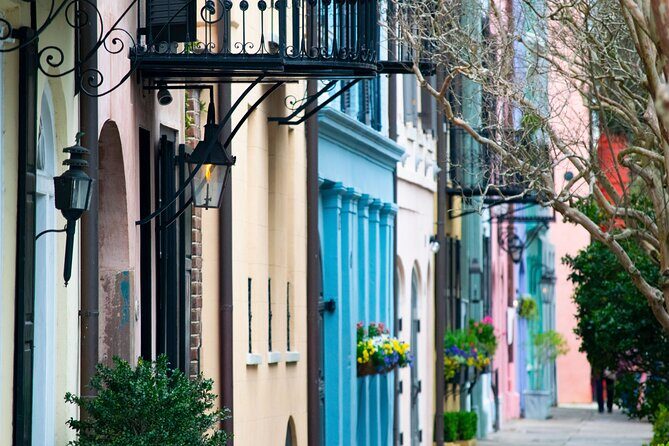
Next comes Rainbow Row, and it’s famous for a reason. You’ll see thirteen colorful historic houses along East Bay Street, with the stretch described as 79 to 107 East Bay Street. The key detail I want you to clock is the geography: north of Tradd St. and south of Elliott St.
Here’s what adds real meaning beyond the photos. Rainbow Row is known as the longest cluster of Georgian row houses in the United States, and the name Rainbow Row was coined after restorations in the 1930s and 1940s, when the pastel colors were brought back.
Why you’ll like this stop: it teaches you how Charleston preserves its face. The buildings may look playful now, but the underlying story is about continuity—how the city keeps certain styles visible, even while everything around them changes.
If you’re short on time, this is also a good place to slow down and look. Stand where you can take in the full line of houses and notice the uniformity, then compare how each facade still feels distinct.
A Charleston single house on Fort Mechanic ruins: engineering before elegance
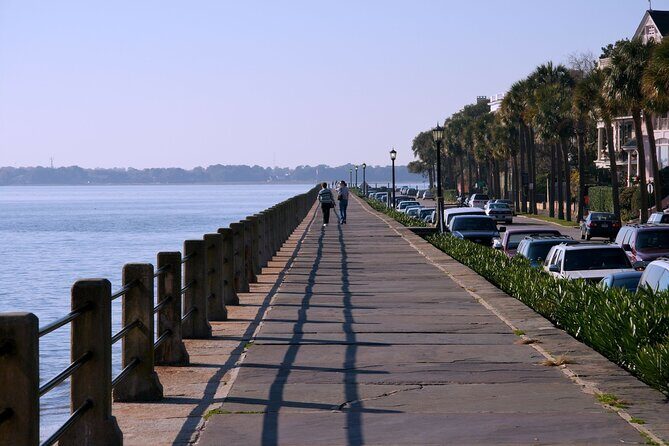
One of the most interesting moments on the route is the house built on a complicated foundation story. The site originally held Fort Mechanic in the later 1700s, but the deeper detail is what happened next: the shipping merchant Charles Edmondston, a Scottish immigrant from the Shetland Islands, bought the low, sandy lot in 1817.
The land was unstable and soggy, and the area wasn’t suitable for residential construction until a sea wall was built. City officials put that sea wall in place in 1820, and then Edmondston began construction.
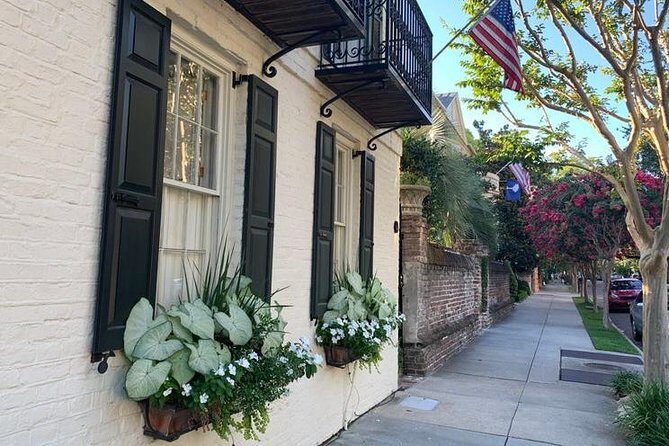
This is where the tour becomes more than sightseeing. You get a firsthand reminder that architecture in Charleston isn’t just about style—it’s about surviving the ground. The house you’ll see is a modified antebellum Charleston single house (side-hall) constructed between 1820 and 1828, and it was originally built in an English Regency architectural style.
What to watch for while you’re there: think of the building as a negotiation between people and place—between design ambitions and a shoreline reality. If you like architecture, this stop delivers. If you don’t usually care about design details, the foundation story is still the kind of fact that makes you pay attention.
White Point Garden and the Battery: harbor views with a defensive purpose
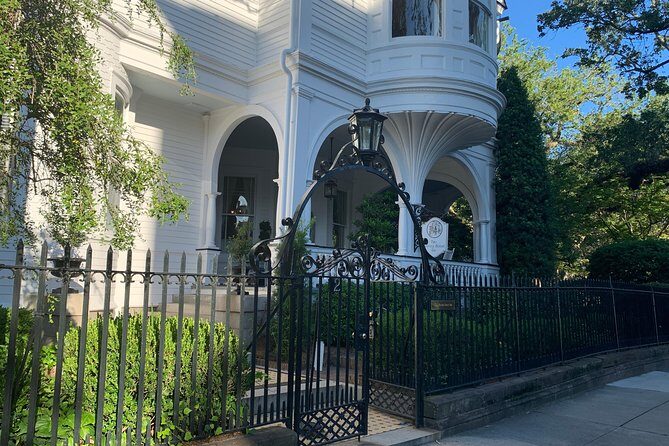
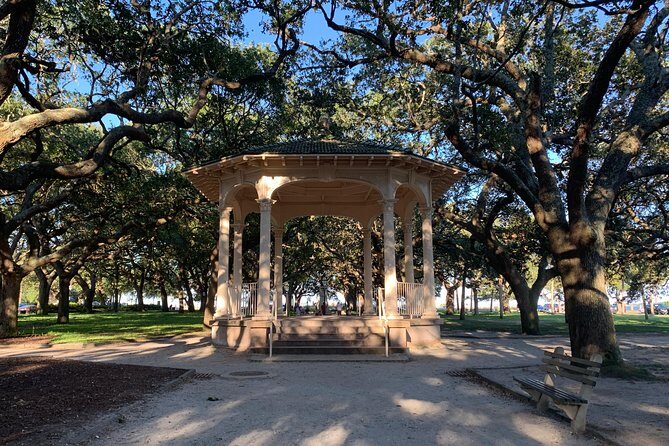
At White Point Garden, you get one of Charleston’s best combinations: a public green space and a setting that still makes you understand the city’s defensive brain. White Point Garden is a 5.7-acre park at the tip of the peninsula, and it’s the southern terminus of the Battery, a defensive seawall and promenade.
The boundaries are clear in the way the tour describes it: East Battery to the east, Murray Blvd. to the south, King St. to the west, and South Battery to the north. That matters because it helps you orient the walk you’re doing—so you’re not just wandering in the general direction of a view.
Why this stop hits: harbor air changes your perspective. Before, you’ve been inside stories or looking at facades. Here, you finally see the “why” behind the city’s geography.
Practical tip: this is a good spot for photos, but also for a quick mental reset. If you’re traveling with kids or teens, this kind of open-view stop tends to keep them engaged without being forced.



Nathaniel Russell House at 51 Meeting Street: neoclassicism with heavy context

Then you move to the Nathaniel Russell House at 51 Meeting Street, one of the city’s major architectural statements. Built in 1808, it was commissioned by Nathaniel Russell, described as a slave trader and wealthy merchant. The house is recognized as one of America’s most important Neoclassical houses and was designated a National Historic Landmark in 1973.
This stop is important because it forces an honest pairing: beauty and harm can coexist in the same structure. I like that the tour’s approach tends to connect the buildings to the lives (and systems) that funded them, rather than treating architecture like it exists in a vacuum.
What you can expect from a stop like this: you’ll spend time absorbing design cues—proportion, style, and the scale that neoclassicism brings. But the real value is how the story frames ownership and power in the period.
If you’re visiting Charleston for the first time, I’d pay attention here to how the guide handles the sensitive subject matter. You’ll learn more about the city by watching how context is explained than by rushing to the next stop.
The Four Corners of Law: one intersection, four institutions
The tour then lands at an intersection that sounds like a joke but points to a real civic story: the Four Corners of Law at Meeting and Broad Streets. The term was coined in the 1930s by Robert Ripley, creator of Ripley’s Believe it or Not!, and it refers to the buildings sitting on each corner.
Here’s what you’ll see mapped out as the guide walks you through it:
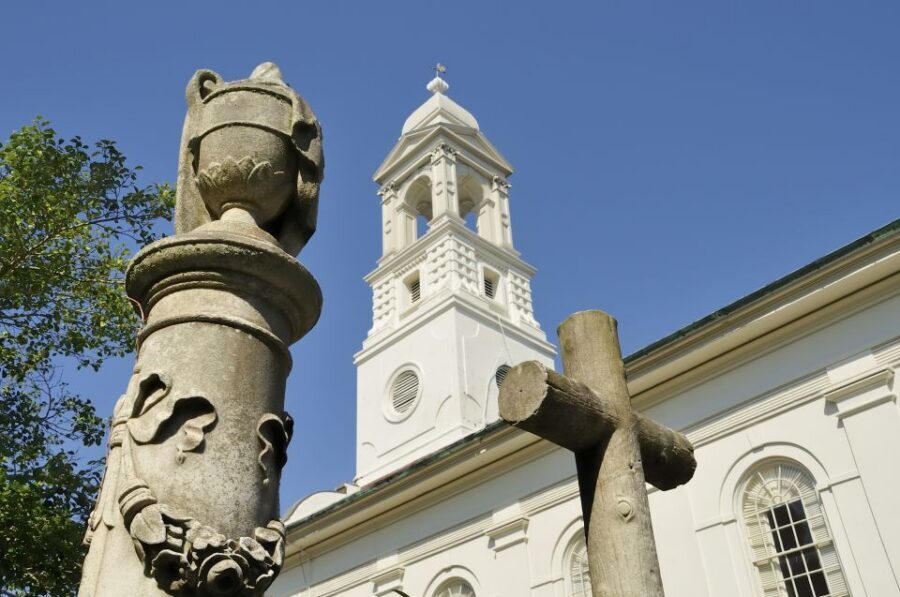
- St. Michael’s Anglican Church, built between 1752 and 1761, on the southeast corner.
- Charleston City Hall, in an Adamesque style built between 1800 and 1804, on the northeast corner.
- Charleston County Courthouse, originally constructed in 1753 as the provincial capital and rebuilt in 1792 as a courthouse, on the northwest corner.
- United States Post Office and Federal Courthouse, built in 1896, on the southwest corner.
Why this matters: it helps you understand Charleston as a city of institutions. This isn’t just a pretty crossroads—it’s a concentrated view of governance, worship, and law across different eras.
If you like history you can see, this stop is efficient. You get a mental timeline without reading a book. And if you’re the type who enjoys trivia, the Ripley connection gives the intersection an extra hook.
How the guide keeps the story moving (and tailored)
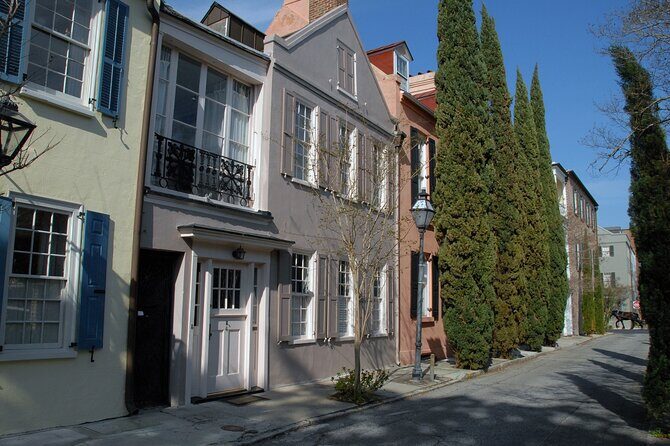
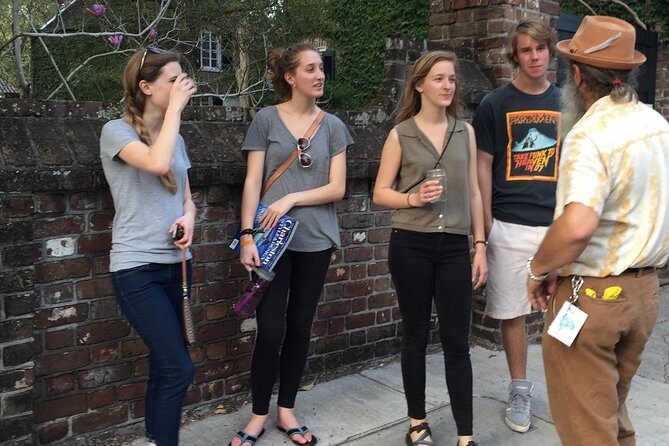
A big part of why this tour works is the way the guide tells it. Guides like Larry are known for being engaging, animated, and highly tuned to what the group already knows. That tailoring matters because you won’t feel talked down to, and you won’t feel like the tour is repeating the same script no matter who shows up.
I also appreciate the balance in the storytelling. The tour doesn’t treat Charleston as a museum behind glass. It connects the past to the present through themes like commerce, government, and the shaping forces of geography and defense.
One more practical point: this tour seems designed to hold attention across ages. If you’re bringing teens, that’s a big deal. A good guide keeps the pace lively without making the facts feel like a random trivia contest.
Price and value: why $35.90 makes sense for what you get
At $35.90 per person for about two hours, this is positioned as a mid-priced city tour with clear built-in value. You’re not just doing exterior photo stops. You also get admission included to the Philip Simmons House and the Halsey Gallery, which is the kind of add-on that can easily push the true value higher than a standard walking tour.
You’re also paying for time saved. Instead of figuring out what matters at each stop (and which buildings are worth your attention), you get the narrative thread: trade and customs, Revolutionary-era significance, Georgian design and restoration, coastal engineering, and a civic timeline at Meeting and Broad.
My rule of thumb: if you have only a day or two in Charleston, guided tours like this can be more efficient than bouncing between sites on your own. If you’re staying longer and planning multiple neighborhoods, you might still book it because it gives you a framework—then the rest of the city reads more clearly.
Smart packing for Charleston walking days
Charleston walking can be deceptively tiring. Even when the route includes shade at times, the weather can change quickly and heat builds fast.
I recommend:
- Wear comfortable, broken-in shoes.
- Bring sunscreen and a hat.
- Carry a bottle of cold water.
- Use a phone for navigation, since this is a mobile ticket tour and your timing depends on meeting points.
If you’re traveling with a service animal, it’s allowed. And since the tour is near public transportation, it’s easier to weave into a longer day.
Should you book this Charleston walking and storytelling tour?
I’d book it if you want a guided walk that’s more than just dates and names. You’ll get clear stops tied to themes—trade, defense, architecture, and civic power—and you’ll also get indoor access through the Philip Simmons House and Halsey Gallery that expands the experience beyond the street view.
Skip it only if you prefer ultra-silent museum style touring, or if you strongly dislike structured walks. This is a story-led format with movement, so you’ll get the best results if you’re ready to walk, listen, and look closely.
If you want a simple decision: this is a solid choice for a first or second visit to Charleston, especially when you’re trying to understand how the city’s geography and institutions shaped what you see today.
FAQ
Where does the tour start?
The tour starts at 122 E Bay St, Charleston, SC 29401, USA.
How long is the Historic Charleston Walking and Storytelling Tour?
It lasts about 2 hours.
How much does the tour cost?
The price is $35.90 per person.
Is the tour offered in English?
Yes, it’s offered in English.
Do I get a mobile ticket?
Yes, the tour uses a mobile ticket.
What’s included besides outdoor sightseeing?
Admission is included to the Philip Simmons House and the Halsey Gallery.
How large is the group?
The tour has a maximum of 20 travelers.
Is the tour suitable for most people?
Yes, most travelers can participate.
What happens if poor weather cancels the tour?
If the tour is canceled due to poor weather, you’ll be offered a different date or a full refund.
How far in advance can I cancel for a full refund?
You can cancel up to 24 hours in advance for a full refund. If you cancel less than 24 hours before the start time, the amount paid is not refunded.